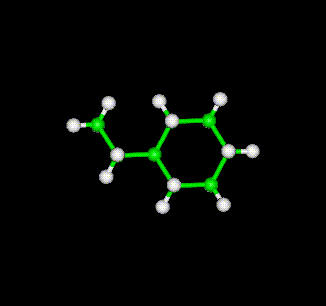
Risk assessment is an inexact science. In fact, let's just go ahead and call it an art. Or maybe it would be more accurate to describe it as a knock-down, drag-out, bare-knuckled brawl between government and industry. Because without a formula to dictate when a state or the feds should step in and declare that something is or is not a carcinogen, that is exactly where we end up. Take styrene for instance.
Polystyrene is one of the oldest "commodity plastics" around, found in everything from beverage cups to bike helmets. Now, citing evidence from its Office of Environmental Health Hazard Assessment, California is invoking the precautionary principle, and is planning to declare styrene - the raw material monomer of the polystyrene molecule - a carcinogen. As you may have heard, the plastics industry has taken its share of lumps lately (see: "Phtheory on Phthalates" below...) and they are none too happy that a mainstay of theirs is about to be labeled as a dangerous, cancer-causing chemical. They fear that consumers will not understand the difference between the occupational risks of styrene exposure in a manufacturing setting, versus those posed by consumer products.
It's anyone's guess where the California Supreme Court will go with this. They could invoke an injunction preventing the OEHHA from making their declaration, or allow it to go forward. Whatever the outcome, each side will cite reams of epidemiological and experimental data in their support, while furiously poking holes in each others' studies.
Without having read all of said evidence, it's difficult to guess who has the stronger leg to stand on. However, there is alot to be said in favor of the precautionary principle. After all, sometimes the weight of evidence is strong enough to take action, even if some questions remain. This may be the case with styrene and this is certainly the approach being taken by European governments under the REACH program. Oh, and don't be surprised when we see similar legislation about BPA and phthalates, too. Sorry, plastic.

No comments:
Post a Comment